By now it’s an old story: It’s 1979, the last few spurts of punk drizzle into either the testosterone jockstrap of hardcore, or the twinky commercialism of “new wave.” And to make matters worse, not even the Real Kids can save power pop. Underground R’n’R looks to the past again for inspiration & direction, to what is still a largely bypassed trip, it looks to 60s punk.
Greg Shaw temporarily folded both Bomp Magazine and the BOMP! label in 1979. He then launched the Voxx imprint to “offer a home to bands working in a purist '60s garage/punk/psych tradition.” At least that’s the story (never mind that Bomp continued releasing classics like Stiv Bators’ "Disconnected" and the Taxi Boys mini-LP). So you can credit Voxx for getting the drop on 80s garage revivalism. At first business was slow, with only a few bands answering the call. Still, the label probably reached its zenith with its first few releases, namely two by San Diego’s Crawdaddys, their 1979 LP “Crawdaddy Express,” a veritable slab of ’64 time-traveled to the Year of the Voxx, and their 1980 EP “5 x 4.” Mike Stax, also of the Tell-Tale Hearts, and editor/publisher of Ugly Things magazine, in a short piece on Voxx included in the book Bomp: Saving the World One Record at a Time, tells of hearing these records on John Peel’s show as a lad, then writing a fan letter to Crawdaddys leader Ron Silva. Silva replied by inviting Stax to come to San Diego from England to play bass for his band. Stax hopped the next plane and the rest is garage revival history. Here’s a couple of cuts from “5 x 4”.
If the Crawdaddys took the purist’s approach, Voxx stalwarts DMZ, fronted by Jeff “Mono Man” Connolly, who would go on to lead one of the greatest of 80s garage bands the Lyres, hammered out a crazed hybrid sound, at times made of equal parts Sonics, Stooges, and 13th Floor Elevators. Shaw helped DMZ get signed to Sire records for their eponymous debut, which kicks ass despite a few flaws like closely mic’d, clicky drums, but which flopped on the sales. Shortly after Sire dropped them, Voxx released some truer sounding DMZ tracks, originally recorded in 1977, on the “Relics” LP. Here’s “Do Not Enter” plus their version of the Standells’ “Barracuda.”
Low-budget recording and packaging was a major part of the Voxx ethos, and Shaw booked cheap studio time at a place called Silvery Moon, in Los Angeles, the city which, with the Cavern Club as its live showcase, functioned as the scene’s ground zero. Unfortunately, it being the 80s and all, the studio featured modern equipment more suited to recording Hollywood hair metal than 60s punk. One of the cuter bands on Voxx, the Pandoras, who came out swinging on their debut LP “It’s About Time,” from 1984, got the Silvery Moon treatment. Then, as if too much of the studio’s effects rubbed off on them, the Pandoras evolved from 60s punk purists to a hair metal band themselves. By ’89 they looked and sounded more like Poison. Leader Paula Pierce died suddenly from some type of brainurism in 1991, aged 31. Here’s their version of the Invictas “Do the Hump,” plus one Paula Pierce original, both from “It’s About Time.” Don’t they sound like nice girls?
So, yes, today’s post offers but a small sampling from the Voxx roster. There were lots more bands, like The Gravedigger V, The Tell-Tale Hearts, The Miracle Workers, The Eyes of Mind, and The Things, to name a few. Also excluded from this post are the great & influential Battle of the Garages comps, just because I don’t own any, and the Acid Visions comp, which, actually, I do have, so maybe down the line I’ll add a couple of tracks from that as an update to this post.
Wednesday, December 30, 2009
Sunday, December 20, 2009
Washing Down the Holidays with Colorado Cool-Aid
Portrait of Red Sovine by Jesse WeidelNeighbor there's no need to let any holiday give you the blues, whether you're talkin' about Christmas, Hannukka, Kwaanzaa, or the passage of our new compromised health care reform bill. Why, all you gotta do is blow off all any and all of it that doesn't involve bright shiny lights, time off from work and school, and all the free grub you can eat. Then skip out to your local non-Judeo-Christian ethnic restaurant and order up some Aloo Vindaloo, extra spicy. And be sure to wash it all down with a couple of nice, cold cans of Colorado Cool-Aid. Which brings us to the real point of today's post, which is to give you, dear reader, a special holiday gift. Introducing Gemini Spacecraft's Washing Down the Holidays with Colorado Cool-Aid playlist. Just download and play. Not a single Christmas song in the lot. And don't say we never give ya nothin'. Happy Holidays.
Playlist:
1. Lester Roadhog Moran - Intro + Liza Jane
2. Donny Young - Shakin' the Blues
3. T. Texas Tyler - Texas Boogie Woogie
4. Red Sovine - Colorado Cool-Aid
5. Lester Roadhog Moran - Monologue
6. Wanda Jackson - Swinging Doors
7. Delmore Brothers - Hillbilly Boogie
8. Guy Drake - Welfare Cadillac
9. Lester Roadhog Moran - Monologue
10. Malcom Yelvington - Yakety Yak
11. Tommy Blake - F-Oldin Money
12. Glen Glenn - One Cup of Coffee
13. Eddie Bond - Boo Bop Da Caa Caa
14. George Jones - Sparkling Brown Eyes
15. Lester Roadhog Moran - Monologue
Tuesday, December 15, 2009
Andy Shernoff Solo

One test of a good song is if it plays well as an acoustic number, or so says Dictators songwriter & mastermind Andy Shernoff. And play ‘em acoustic is exactly what Shernoff did for about an hour last night at the Lakeside Lounge, in New York City, in the final installment of the amazing Monday happy hour thing he’s been doing there for the past few weeks. And play ‘em ain’t all he did. He told a few too--stories, anecdotes, and jokes to introduce the numbers, revealing something new about each song. For example, writer Richard “Jimmy Borneo” Meltzer apparently loved party gags, and would sometimes place a cup of his own piss among a soiree’s snacks & hordy-orvys, and the death of Joey Ramone, for whom Shernoff wrote the great “Stop Thinking About It,” was even sadder than you know.
Something about the interplay of these stories and songs lent extra impact to the proceedings, producing some rare effect that these two elements working separately would never hit. The more he talked and played the more exhilarating and trance-like the set became. When introducing “New York, New York,” a song about a city that no longer exists, Shernoff remarked that “Now New York is one big mall filled with hillbillies.” How ironic to hear him play the song, moments later, and stare through the Lakeside’s window at the street outside, watching the passersby, the bourgeois bohemians and neat bankers who now roam Avenue B. Occasionally these passersby would glance inside at the oddity onstage. What did they see? Just some guy strumming an acoustic guitar?
Saturday, December 5, 2009
New Arrival to the GS Bookshelf: Folk Photography by Luc Sante

Luc Sante, author of that great history of vice on the Bowery, Low Life: Lures and Snares of Old New York, apparently collects early 20th Century picture postcards. From his collection of more than 2500 cards he assembled his latest book Folk Photography, The American Real-Photo Postcard 1905-1930 (Yeti/VerseChorus, 2009).
Sante distinguishes Real-Photo Postcards from the more widespread photo-litho cards of the day, as the former were printed in darkrooms, on photo paper, and in limited runs. They originally appeared as a result of several key convergences. In 1905 the postal service inaugurated the penny postcard rate, and then Rural Free Delivery the following year. At about the same time photography became more accessible to the layman thanks largely to the advent of simpler developing processes and cheap cameras. Before long every lonesome whistle-stop in Prairieville had its local photog, ready and able, for a fee, to document people and events in sepia tone to show to the folks back home.
This plain-faced popular form, which Sante reminds us was an essential means of communication during its day, was derided by the guardians of more self-consciously arty-farty photography of the time. Alfred Stieglitz considered the subjects of most photo postcards too banal, and their execution too amateurish. However, in his accompanying treatise, Sante argues for the democratic quality of the real-photo postcard. Borrowing crit-speak from Barthe’s Camera Obscura, he insists that the best RPPCs qualify as art, as they possess both studium and punctum. That is, they both capture something essential about their time and place, the studium, while also “puncturing” the viewer with their emotional power.
Labels:
Folk Photography,
Luc Sante,
Real-Photo Postcards
Friday, November 27, 2009
Burn K-Doe Burn!

Ernie K-Doe: The Black Liberace, Emperor of the Universe, and posthumous mayoral candidate for the City of New Orleans. The following WWOZ aircheck gives a good example of his dynamic, on-air personality, while offering useful wisdom for roosters, hens, and charity hospital babies.
Thanks to WFMU’s Rock ‘n’ Soul Ichiban for originally posting this aircheck.
Wednesday, November 25, 2009
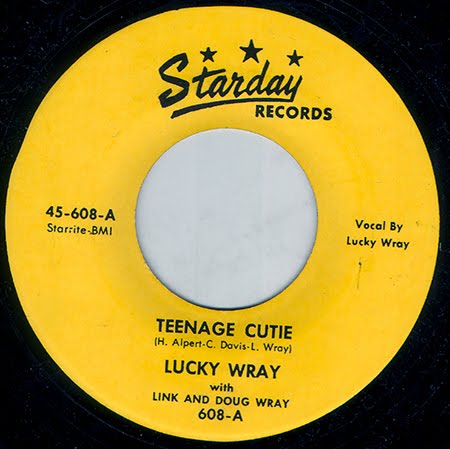
Lucky Wray & Little Walter: Teenage Twin-Pack

“Teenage Cutie,” Lucky Wray & The Palomino Ranch Gang, a/k/a Link Wray in his Stetson-wearin’, cowboy movie-watchin’ days, waxed this one for Pappy Daily’s Starday Records back in 1955. I’m pretty sure that’s Link on the vocals, just before a bout of consumption would claim one of his lungs, which is largely why he played mostly instros for the rest of his career. Doctor’s orders!

“Teenage Beat,” Little Walter (Checker 845). A blazin’ instro from 1956. Basically a looser, improvised work-out on the same groove that drives “My Babe.” But this track--something to get the teenies dancing, no doubt--rocks harder than the big hit, presented here in the same scratch-o-phonic hi fidelity you've come to expect from Gemini Spacecraft.
Sunday, November 15, 2009
Roy Hall & Amos Milburn

The paths of Roy Hall & Amos Milburn may never have crossed in any notable way, except in the annals of Unsung Heroes of Rock ‘n’ Roll, by Nick Tosches, which features excellent profiles on them both. Still, here at Gemini Spacecraft, the Cohutta Mountain Boy and the slick Chicken-Shacker have come to resemble two hands on the same boogie piano.
Both Hall and Milburn cut their earliest sides in the late 40s, back in the days of the 78 single. Both knew the blurry, bleary wonders of the after-hours joint. While Milburn had a string of hits, most notably 1948’s “Chicken Shack Boogie” (Aladdin 3014), none of Hall’s own great records would ever hit, although his most famous song “Whole Lotta Shakin’ Goin On” (Decca 29697) obviously blew the world wide open for Jerry Lee Lewis in 1957.
Like the booze he loved and sang so well about, Milburn’s genius was concentrated, in this case, in the decade spanning 1946 to roughly 1956. During this period, while recording for Aladdin, he cut the aforementioned “Chicken Shack Boogie,” plus the dirty dittie “Walking Blues,” also “Let’s Rock Awhile,” “Good Good Whiskey,” its remorseful inverse “Bad Bad Whiskey,” also “One Scotch, One Bourbon, One Beer,” “My Happiness Depends on You,” and my personal favorite, his version of Don Raye’s “Down the Road Apiece.” Both Chuck Berry and the Rolling Stones did their own great versions of "Down the Road a Piece." But where those acts each rocked it as a full combo, Milburn, accompanied only by a snare drum, pumps that piano boogie until it sounds like an entire, crazy band. Not long after, Aladdin Records folded. Milburn migrated over to the King label, and, in the early 60s cut a couple of duets with Charles Brown. Eventually the hard drinkin’ caught up with him, and after several strokes, Amos Milburn died in Houston in 1980.
Put a lascivious, drunk hillbilly behind what is essentially the same twelve-bar boogie, then hit the drums a little harder and crank up the gee-tar, and you get Roy Hall. His first band, Roy Hall and the Cohutta Moutain Boys, were among the earliest on the legendary Fortune label, who in 1949 released “Dirty Boogie” (Fortune 126) and five other sides. After that, Hall returned to Nashville where he ran an after-hours joint called the Music Box, cut a few sides for the Bullet label, “Mule Boogie,” (Bullet 704) from 1950, among them, and played piano for Webb Pierce. Webb helped Roy get a deal with Decca Records, where Hall’s music moved a few steps away its earlier hillbilly blues stylings toward something much closer to rockabilly in songs like “Diggin’ the Boogie,” “Three Alley Cats,” “See You Later Alligator,” and “Don’t Stop Now.” Despite a lack of hits, and music biz rip-offs, Hall kept rockin’, seeming to get raunchier with each new record. By the late 50s he’d returned to Fortune, recording for their subsidiary, the Hi-Q label. Here he re-worked a couple of earlier gems like “Dig, Everybody, Dig That Boogie” and “Three Alley Cats,” while also releasing the great “Bedspring Motel.” Then, in 1960, for his former boss Webb Pierce’s short-lived Pierce label, under the name “The Hound,” Hall made one of the dirtiest records you’ll ever hear, “Flood of Love,” b-side to the great “One Monkey Can’t Stop the Show.”
Both men quit drinking in the last years of their lives, and while those strokes left Milburn an invalid, unable to stomp out that piano boogie thanks to the loss of a leg, Hall kept rockin’ into geezer-hood, until his card got punched in 1984.
Saturday, November 7, 2009
The Weekly BOMP! - The Zantees "Out for Kicks"

Released by Bomp in 1980, the Zantees first long player Out for Kicks is like some old V-8 lunging off the line, building power and speed as it goes. Here at the Gemini Spacecraft archive it gets shelved beside the Blasters’ American Music and Alex Chilton’s Like Flies on Sherbert, two other great 1980 LPs that helped spark that branch of postpunk that Greg Shaw dubbed “Real Rockers,” rightfully reclaiming the word from “the same creeps who took over new wave,” who were then trying to apply “Rocker” to “that lethargic sludge they worship as reggae.” Shaw asserted that only “records with that frantic beat that makes you want to go hog wild” deserved to be called “Rocker.” And Out for Kicks definitely lives up to Shaw’s criteria.
The Zantees line-up included Billy Miller and Miriam Linna, on the vocals and tubs respectively, then of Kicks Magazine, soon to launch Norton Records, teamed up with guitarist brothers Paul & Bill Statile and bassist Rob Norris in a sort of proto A-Bones, if you will. As for the words to describe their sound, let Shaw say it, “Some folks call the Zantees a rockabilly band, but they’re not. They’re so much more than that. They’re a Rock ‘n’ Roll band in the strongest sense, having grabbed inspiration from all the high points of the past 30 years including not only rockabilly but punk, invasion, surfing, and maniac R&B and bashed it all into a style that’s indefinable.”
On Out for Kicks, dig how the Statile brothers' string-wringin' calls to mind that of Paul Burlison, Cliff Gallup, and others, then mixes it all together, sometimes simultaneously, sometimes even in the same riff! And Billy Miller’s wild vocals here display a spastic youthfulness not as apparent on later A-Bones records. Add Miriam Linna’s “hog wild” beat, and a heapin’ helpin’ of reverb on the vocals, guitars, drums, and, hell, everywhere, and you get a real classic. Now out of print, but not too hard to track down.
Greg Shaw quotes originally from Bomp! Magazine, now reprinted in Bomp! Saving the World One Record at a Time (Ammo, 2007).
Songs:
"Blonde Bombshell," "Big Green Car," and "Gas Up," from Out for Kicks (Bomp! LP 4009).
Labels:
BOMP Records,
Greg Shaw,
Out for Kicks,
Zantees
Saturday, October 31, 2009
Print Ephemera #2: WFMU's "Crackpots & Visionaries" Trading Cards

...Or, WFMU Record Fair Finds Part II: Crackpots & Visionaries trading cards.
Pictured here is Volume I, from 1992. Ya get 36 cards with captioned bios of a wide range of characters from William S. Burroughs to Jesse Helms, each illustrated by some luminary of 1990s underground comics. Artists include Dan Clowes, Roy "Trailer Trash" Tompkins, Julie Doucet, Joe Coleman, and lots of others.
#30 The Patron Crackpot of this blog, the Legendary Stardust Cowboy, drawn by J.R. Williams.
Subscribe to:
Posts (Atom)