
Saturday, January 31, 2009
Small Faces and Stanley Unwin: You're Talkin' Gobbledygook!
Pictured above is British comic Professor Stanley Unwin, aka Codlington Corthusite, aka the Chancellor of Vulgaria, inventor of his own language of gobbledygook "Unwinese." Imagine James Joyce's opening rap in Portrait of the Artist crossed with some sort of strange, Midlands jive. BBC Radio announcer once a polly tito, Unwin also narrated the tale that runs through the Small Faces rather twee Ogden's Nut Flake LP, their foray down the dodgy mews of British rock opera. What the hell, I like the song "Lazy Sunday" well enough. Here it is from a German television appearance from '67.
The brief clip of Unwin, his epilogue to the tale on ONF, comes from a British television broadcast of the Small Faces performing the entire album live, circa 1968. As he says, "Stay cool, man. Stay cool."

Thursday, January 29, 2009
Hollywood Suicide #2: Pina Pellicer

During her brief run on the screen, Pina Pellicer was more well-known in Mexico and Europe than the US. Daughter of an affluent Mexico City lawyer, niece to a famous modernist poet, and sister to a tele-novela actress, Josefina Yolanda Pellicer López de Llergo had art--not to mention a wicked long name--in her blood. But then, the old world leisure class often had art in its blood (and time on its hands).
She first appeared in a Mexican production of Macario, released in 1960, the Academy's runner-up for best foreign film for that year. That Macario came first for Pina Pellicer was Marlon Brando's fault. She'd already had a role in One-Eyed Jacks, the weird transitional western that Brando commandeered from director Stanley Kubrick and writers Sam Peckinpah and Rod Serling. It began production in '58. However, as Brando's ego sent director & writers packin, and the enfant terrible took over, work on the film slowed. The new actor/director shot more and more film, release dates got postponed, and the picture didn't hit theaters until '61.
 In One-Eyed Jacks--which also stars Karl Malden, Slim Pickens, Timothoy Carey, Katy Jurado, Ben Johnson, and Larry Duran--Pina plays Luisa, adopted daughter of former thief turned scum-bucket sherriff Dad Longworth (Malden). As part of his revenge on Longworth for an old doublecross back in their bank robbing days, the outlaw Rio (Brando), cons the pretty step-daughter out of her virtue. Here's a clip.
Wish I could find a clip of one of the film's finer moments, when Dad's evil deputy Lon (Pickens), tips him to Luisa's new condition. "She came in this morning," he whispers, "A-lookin' kinda messy." As compensation for my failure to find this clip, I offer Timothy Carey's scene (if there's a bad movie with Tim Carey, I never saw it), the one with the classic "Get up, you tub-o-guts!" line.
So what happened to Pina Pellicer? Was her 1964 suicide, in Mexico City, at age 30, another case of life imitating art? (All that art in the blood.) Some like to interpret from the storyline in One-Eyed Jacks that Pina and Brando had their own real-life case of unrequited love. Leading man snubbed leading lady, etc., etc. But she died several years after her brush with the big man. Maybe she had a vision of the future, and it showed her The Island of Dr. Moreau. Other rumors claimed that she wasn't hung up on Brando at all, but that she was bugged by the the same sort of difficulties that beset Montgomery Clift, and the resulting depression made Pina Pellicer take that early bow.
Monday, January 26, 2009
High Water Records
When in "High Water Everywhere," Charley Patton sings “the water was rising, up to my front door,” you know the end is near. It seems fitting then, that as the end approached for the blues, the last generation of great performers would record for a label with the same name.

The High Water Recording Company was founded by David Evans in 1979, as part of Memphis State University’s College of Communication and Fine Arts. Original funding came from the NEA. Such factoids make High Water sound like one more exercise in academic blues-ology, producing more fodder for the folkways archives, destined to be alphabetized by German collectors. However, thanks to Evans’ grasp of his local scene, and his embrace of the good old commercial impulse and its ultimate format, the 45, the records he produced transcend more traditional field recordings made by Alan Lomax, Chris Strachwiz, and Evans himself on earlier outings.

Initially the NEA gave High Water enough money for four singles, with the aim of preserving some of the region’s rich musical/cultural thing-a-ma-ling. Evans would capture the last utterances of Big Joe Williams, Sam Chatmon, and others from that older, already well-known generation. Or so the NEA thought.

But Evans wanted to model High Water after what Sam Phillips originally did at Sun Records by making the first records by a younger generation previously unknown beyond their own home turf. Evans even began numbering the High Water catalog by picking up where Sun had left off with their last single. The first of these was “Going Down” b/w “Cotton Fields” and “Boss Man” (HW 408), by one of Ike Turner’s original sidemen, sax honker Raymond Hill and his wife Lillie. Also in that original set of four was Jessie Mae Hemphill’s set of hypnotic Senatobia blues “Jessie’s Boogie” b/w “Standing in My Doorway Crying” (HW 409), R.L. Burnside’s backwoods soul “Bad Luck City” b/w more traditional hill blues “Jumper Hanging Out on the Line” (HW 410), and Rainie Burnette’s droning “Coal Black Mattie” b/w “Hungry Spell” (HW 411).

With these and subsequent High Water releases, Evans hoped to help the blues reenter the stream of popular music, at least regionally. And the format, 45s, helped keep ‘em funky, affordable, ready-made for radio play and jukeboxes. These records represented the latest thing by their performers, and some even held their own on local radio, thanks to the support of area dj’s, Rufus Thomas, the world’s oldest teenager, among them. (Ironically, Thomas was one of many black artists dropped by Sam Phillips once he had Elvis in his stable.)
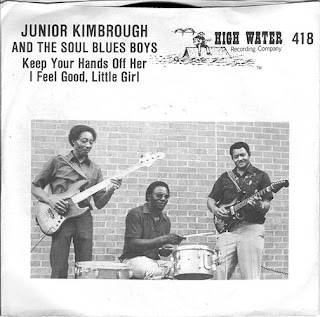
High Water’s next two singles, (HW 412 & 413) released in ’81, by Memphis favorites the Fieldstones, were also some of its most successful. During this period harp-meister and Bobby Bland-styled singer, Little Applewhite cut a couple of singles which also did fairly well on Memphis and Chicago stations.
Besides releasing some of the earliest records by R.L. Burnside, Jr. Kimbrough, and Jessie Mae Hemphill (granddaughter of the great pre-war musician Sid Hemphill, one of Lomax’s big field discoveries), High Water breathed new life into the career of harp-blower and jug-band master Hammie Nixon, former sideman to Sleepy John Estes, whose “It’s a Good Place to Go” b/w “Bottle Up and Go” (HW 416) stands out as one of the best records in their catalog.


The High Water Recording Company was founded by David Evans in 1979, as part of Memphis State University’s College of Communication and Fine Arts. Original funding came from the NEA. Such factoids make High Water sound like one more exercise in academic blues-ology, producing more fodder for the folkways archives, destined to be alphabetized by German collectors. However, thanks to Evans’ grasp of his local scene, and his embrace of the good old commercial impulse and its ultimate format, the 45, the records he produced transcend more traditional field recordings made by Alan Lomax, Chris Strachwiz, and Evans himself on earlier outings.

Initially the NEA gave High Water enough money for four singles, with the aim of preserving some of the region’s rich musical/cultural thing-a-ma-ling. Evans would capture the last utterances of Big Joe Williams, Sam Chatmon, and others from that older, already well-known generation. Or so the NEA thought.

But Evans wanted to model High Water after what Sam Phillips originally did at Sun Records by making the first records by a younger generation previously unknown beyond their own home turf. Evans even began numbering the High Water catalog by picking up where Sun had left off with their last single. The first of these was “Going Down” b/w “Cotton Fields” and “Boss Man” (HW 408), by one of Ike Turner’s original sidemen, sax honker Raymond Hill and his wife Lillie. Also in that original set of four was Jessie Mae Hemphill’s set of hypnotic Senatobia blues “Jessie’s Boogie” b/w “Standing in My Doorway Crying” (HW 409), R.L. Burnside’s backwoods soul “Bad Luck City” b/w more traditional hill blues “Jumper Hanging Out on the Line” (HW 410), and Rainie Burnette’s droning “Coal Black Mattie” b/w “Hungry Spell” (HW 411).

With these and subsequent High Water releases, Evans hoped to help the blues reenter the stream of popular music, at least regionally. And the format, 45s, helped keep ‘em funky, affordable, ready-made for radio play and jukeboxes. These records represented the latest thing by their performers, and some even held their own on local radio, thanks to the support of area dj’s, Rufus Thomas, the world’s oldest teenager, among them. (Ironically, Thomas was one of many black artists dropped by Sam Phillips once he had Elvis in his stable.)

High Water’s next two singles, (HW 412 & 413) released in ’81, by Memphis favorites the Fieldstones, were also some of its most successful. During this period harp-meister and Bobby Bland-styled singer, Little Applewhite cut a couple of singles which also did fairly well on Memphis and Chicago stations.
Besides releasing some of the earliest records by R.L. Burnside, Jr. Kimbrough, and Jessie Mae Hemphill (granddaughter of the great pre-war musician Sid Hemphill, one of Lomax’s big field discoveries), High Water breathed new life into the career of harp-blower and jug-band master Hammie Nixon, former sideman to Sleepy John Estes, whose “It’s a Good Place to Go” b/w “Bottle Up and Go” (HW 416) stands out as one of the best records in their catalog.

Eventually High Water got into long players, and released fewer 45s. One of the last was the Harmonizers doing the great gospel numbers “I’ll Be Satisfied” b/w “Trampin’.” Here and there High Water got a few unlucky breaks. Hammie Nixon passed. Overseas licensing deals fell through. By '89 Evans threw in the towell (although High Tone records has since reissued much of the High Water catalog). And maybe it was a wise move. By then High Water had achieved Evans' goal of exposing these hitherto obscure artists to a wider audience. Jessie Mae got her Handy Award before she passed. R.L. and Junior Kimbrough made it over to Fat Possum Records and enjoyed several years of noteriety before they passed. Time ain’t no friend of the blues.
******
The Junior Kimbrough video was made by Little Ruby Pictures, the same folks who brought you the film "Wayne County Ramblin'." For more info go to http://www.waynecountyramblin.com/
Monday, January 19, 2009
Hollywood Suicide #1: Laurie Bird
 Her career began auspiciously enough. Based on her skinny, hippy vagabond good looks, and her power to convey that vibe, she won parts in Monte Hellman's two best films: Two Lane Blacktop (1971), and Cockfighter (1974), acting alongside such greats as Warren Oates and Harry Dean Stanton. In Blacktop she plays, well, a skinny, hippy vagabond named simply "the Girl." She enters the story as a hitchhiker, picked up by the Driver (James Taylor) and his Mechanic (Dennis Wilson) in the early stages of their cross-country race against G.T.O. (Warren Oates).
 Before long the Girl realizes that her partners, a couple of rat-roddin', boiled egg-eatin', silent types, are more interested in nuts and rods than fooling around with her, so she switches sides to ride shotgun with G.T.O.
This youtube clip, from some joker's "condensed" version of Blacktop, captures the Girl's feeling of neglect at the hands of these gear-heads, as well as Bird's best line in the film.
From there Hellman seemed to establish a sort of swapped woman typecast for Bird. Next she pla ys Dodie White in Hellman's adaptation of the Charles Willeford novel Cockfighter (also released as Born to Kill). Dodie's another character who's subject to tight-lipped men who won't pay her any mind. In one early scene, former chicken-fighting champion Frank Mansfield (Oates), on another losing streak, bequeaths Dodie, along with his trailer, to gloating Jack Burke (Stanton) as payment for a lost bet.

After Cockfighter things seemed to go downhill for Laurie Bird. By '75 she was no longer shacked with Monte Hellman. She hooked up with Art Garfunkel. (Another 70's pitfall? Besides the threat of getting caught wearing earth shoes, a young hippy vagabond could end up hanging with yacht-poppers.) They left L.A. together and returned to New York to live in his Manhattan penthouse. Also a photographer, Bird shot the jacket photos for Garf's 1978 Watermark LP (she also shot stills for Cockfighter). She took a minor role in Annie Hall, playing Paul Simon's girlfriend. Still wonder why she killed herself? She went from Two Lane Blacktop & Cockfighter to being sandwiched between Simon and Garfunkel. In 1979, at age 25, while Garf was away shooting the Nicolas Roeg film Bad Timing, Bird offed herself in his apartment by overdosing on valium, citing depression in her suicide note. At her funeral, Bird's father revealed that her mother had also committed suicide.
A couple of quotes regarding Bird's tragic demise:
Charles Willeford: "(Bird) leaped out of a window and killed herself in New York. She was with a famous pop singer when she defenestrated herself, and he was quite upset by her suicide."
Monte Hellman: "Although the overdose of valium was not accidental, Laurie expected Art Garfunkel to arrive momentarily and save her, and therefore didn't intend to die."
Friday, January 2, 2009
More Piss on Yer Parade
 It's happened before, and for a while now he'd been threatening to do it again. Tim Warren, il duce of the Crypt family of fine record labels, recently closed shop at the Brooklyn store --the last good R'n'R record store in NY?-- and US mail order, and packed it off for Germany.
I don't know the circumstances (I suppose a real journalist would get the story --Washington Post I ain't), but I can imagine how tough it's gotta be for record stores/wholesalers/labels these days, what with downloads, the bad economy, and the all-around shitty taste of the music consuming public.
Speaking of the public's shitty taste, here are a few ads for the Crypt label. These were always good for a gob in the face of the music underground that, to hear Warren tell it, never gave Crypt no respect. These three date from the late 80s-early 90s. They're pretty typical of the kind of thing you'd see in 'zines back then. What the hell, the blogosphere is just the modern version of 'zine-dom, so why not reproduce these ads as a sort of tribute? For me personally they provided early exposure to an alluring world of Raunch 'n' Roll sleaze. Funny, Crypt's always been the red-headed stepchild of underground music, but everyone knows about 'em. I doubt I've got to tell anyone about the Back from the Grave, Sin Alley, Desperate Rock 'n' Roll, Strummin' Mental, and Las Vegas Grind comps, or their role in shaping garage rock over the past 25 years.

These ads all originally ran in Forced Exposure, which, tho sympathetic to the raunch, was pretty heavily into the very "prog rock shit" under attack here. The crude layout, cartoons, and insults always made me laugh, and had a way of making me feel like a jerk for listening to anything not released by Crypt. I like how the thanks ("to cool stations that have the BALLS play raw indy shit") were often balanced by big Fuckyous ("to pussy stations that play Elvis Cosdildo" etc.). And dig the artwork by Dan Clowes and Mort Todd.
The last one here dates from the 1st time Crypt bailed for Hamburg, circa 1990. It kinda shows how little has changed over the years. Maybe you could add a couple more types of douche-bag music consumer (see the longhairs at bottom), but that's about all. Anyway, it's still possible to order stuff from them, but Americans now gotta pay overseas shipping. I'll miss the store, where Tim would insist that you play your selections on the store turntable, often while demonstrating his talent for keeping several simultaneous conversations running --with other customers (when he had 'em), with the dog, over the phone.

Saturday, December 27, 2008
Hillbilly Highway

Like a lot of culture vultures with an appetite for so-called Americana, I'm ambivalent about the sticks. I'll sing along to Terry Fell one minute, then lapse into Easy Rider style hicko-phobia the next. On my recent drive from Boston to Austin, which took me through parts of Appalachia, the Ohio River Valley, and the Ozarks, I had plenty of opportunity to swing between extremes.
Here's a partial diary:
December 22, 2008: I gotta wonder, are the ugliest people in the US scattered along I-70? Driving west thru Washington, PA, Wheeling, WV, and Columbus, OH, I get the impression that every rest stop, gas station, and quickie mart we hit is full of fat, drawling mutants lining up to buy Big Gulp Mountain Dew. Caught a bad dose of the heartland horrors at a Wendy's just outside of Zanesville, OH, surrounded by characters that could have come straight from Roy Tompkins' "Trailer Trash" comic. None of us really ate our fastfood --so soft and bland, almost like babyfood-- so much as we seemed to absorb it thru large facial orifice.

December 23, 2008: Left Dad's place in the St. Louis suburbs, drove thru late afternoon rains along I-44, which follows the old Route 66. East of Springfield, MO, we stopped at one of those corny souvenir/antique shops dotting the highway here. Turns out they had a big bin full of C&W records.
Scored a mono copy of that 1st Webb Pierce LP. One big highlight here is his version of Jimmie Rodgers' "He's in the Jailhouse Now." Great country boogie guitar on that one. Was Roy Hall playing piano for Webb at that point?

Also picked up a mono copy of the Johnny Paycheck LP "Jukebox Charlie", on Aubrey Mayhew's Little Darlin' label. Crazy steel guitar provided by Lloyd Green. One of my favorites here is their version of Bobby Bare's "Motel Time Again."

Finally, I couldn't resist cornball Johnny Bond party record "Ten Little Bottles" on Starday, which features the boozer's singalong "Three Sheets in the Wind".

December 23, 2008: Took highway 65 outta Springfield, MO, thru silly-ass Branson, bound for Little Rock. This road goes thru Ozarks, eerie hollers and pitch-black woods. Fog was so thick at certain points that we could see no more than 10 feet in front of the car. So that slowed us down to an utterly tedious 20mph for almost 50 miles. Easy Rider phobia kicked in hard at this point. I could see us trying to rest at a mountain turn-off, to end up getting moonshined, or hip-mo-tized by Ozark myth monster the Yarp, or otherwise devoured by the evil lurking in the American wilderness. I was never so happy to see a Tiger Mart open in the middle of the night as when we finally reached Conway, AR.
********
Illustration: Harvey the Hillbilly Bastard, by Roy Tompkins
Wednesday, December 17, 2008
Still Paying the Rent

By now, thirty years after the release of their first single, Jeff Conolly's band the Lyres have become sorta like their namesake ancient instrument. They've been here among us since the earliest days. Cities come and go. Civilizations rise, fall, and burn. But the Lyres remain. In the underground rock universe, thirty years is a long goddamned time.
Maybe they've released nothing new since... when? 2003? But who cares? Especially when Conolly, who's hired and fired more musicians over the years maybe even than Buddy Rich, currently leads his greatest line-up through the monthly hometown "rent gig." Drummer Paul "Machine Gun" Murphy, bassist Rick Corraccio, wh
 o both played with Conolly in the mighty DMZ, and guitarist Dan McCormack (along with Conolly himself on vocals and vox) make up the same band that plays on the classic 1984 On Fyre LP, as well as the "She Pays the Rent" EP from the following year, both released on Rick Harte's Ace of Hearts label.
On Fyre, which for several months in '84-'85 held a steady position on the college radio charts, demonstrates the Lyres' cover song effect pretty well. Mingling there with signature Conolloid originals "Help You Ann" and "Don't Give It Up Now" are a couple of Kinks tunes, another by the New Colony Six, and one by Pete Best, "The Way I Feel About You." Likewise, the "Lyres, Early Days" live CD, a merger of two earlier, oop live LP's on Crypt, features tons of covers, with work-outs of material mostly by American bands like the Wailers, Don & the Goodtimes, and the Chocolate Watchband. Nowadays, the live set seems to emphasize Conolly's fascination with Wally Tax and Tony Jackson. These two currents of 60's punk --that Northwest sound, and the European, or what's now called freakbeat, have fueled Conolly's output going back to the DMZ days.
According to Brett Milano's Vinyl Junkies: Adventures in Record Collecting, Conolly follows a code when selecting the band's cover material. The Lyres only play songs which he owns in original form, as singles. To think of it sorta boggles a record collector's mind. Imagine, original versions of "Enough of What I Need" by San Antonio thugs the Stoics, "Wasting My Time" by the New Breed, "Talk About Her" by the Sevens, all current rent gig regulars. Tony Jackson? Forget it. You couldn't find it even if you had the dough. As Conolly says, as quoted in Milano's book, "I'm not a collector, I'm a friggin' archivist."
That he makes these songs his own speaks, I think, to Conolly's talent as a stylist. And that's a talent that don't get too much cred these days. But there was a time when careers were built as much on interpretation and delivery as composition. The Coasters did their Lieber-Stoller. Jerry Lee Lewis played, well, everything. And their versions of the chosen material often stand out as the best. In some cases, I think the same can be said for Conolly's covers. Like for rockin' power and menace, I'll take the Lyres' version of "No Reason to Complain," and Don & the Goodtimes wish they sounded as good playing their own "Little Sally Tease."
By harping on Jeff Conolly as a song stylist, I don't mean to detract from his song writing. And he's penned some rockers. If you add it all up, the split's about 50/50, covers vs. originals. Not a bad rate, over the course of a R'n'R career. Like Axl Chitlin has said, an artist is doing good to write one decent song ever, great if they write one per year. This bit about churning out an album's worth of original material each year is a standard propagated by record companies, and has only led to an increasingly vast heap of insipid dreck.
 So is Jeff Conolly the Jerry Lee of 60's (by way of 80's-2000's) garage punk? Go ahead, try that one on for size. The fit might feel a little loose at first. Still, many have tried, but few, including many from that original crop that Conolly first sought to emulate, have managed to bash this stuff out so relentlessly, for so long, and with such skill. As others have noted, most garage bands from the last thirty years have merely been Lyres-in-training. And barring the occasional break or hiatus, Conolly & Co still belt out some of the best live R'n'R you're likely to hear in these suckshit times, and they do it almost every month. And it's still possible on those truly special nights down in the dank basement of the Cantab Lounge, in Central Square, to hear 'em run through practically the entire songbook, no matter how indifferent the world might be at this point. And how often does that happen in your town?
******
Although I'm partial to those old Ace of Hearts records, nearly all of the Lyres' best releases were reissued on CD by Matador Records about 10 years ago. I think many of these are still in print 'coz I still see them in the bins from time to time, and they always include lots of great bonus cuts and scattered EP's. Tim Warren keeps most of those Crypt releases in print too.
Thanks to Stevie Gomez for use of the band photos.
Friday, December 12, 2008
Shootin' My Spacegun


I ain't no autogaph collector, or handwriting analyzer, but here's my favorite show-biz signature, scrawled by... Well, you can read for yourself. The Ledge's original version of the song "I Took a Trip on a Gemini Spacecraft", not Bowie's suckshit disco version, inspired the name for this blog. I'm currently unable to post the song, since the copy I have is on vinyl and I don't yet own one of those USB turntables. But here's some Youtube footage of his appearance on Rowan & Martin's Laugh-In. When? '67-'68?
The portrait was taken by Stephanie Chernikowski and originally ran in Forced Exposure (#16), from around '90-'91, just one of her many great shots that appeared in that magazine.
Wednesday, December 3, 2008
You Oughta Do Like Me and Get on Down to Lansky Brothers

Screamin' Jay Hawkins & Cinque Lee in a still from Mystery Train. Screamin' Jay's suit from Lansky Bros., Memphis, TN.
Subscribe to:
Posts (Atom)